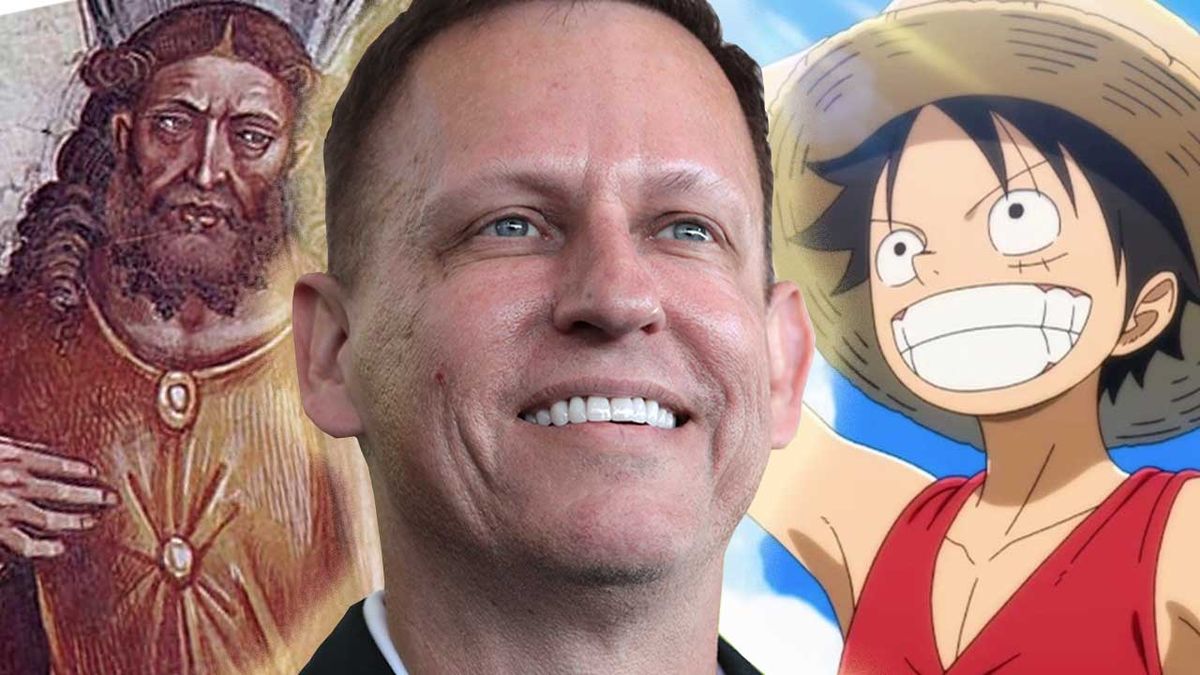
Peter Thiel, The Anti-Christ and Monkey D. Luffy Walk Into A Bar - Thiel Lecture #2
Sorry, there’s no joke here, just a tech billionaire losing his mind via powerpoint and manga.

Editor’s note: This is a guest post from an researcher and writer we’re giving the pseudonym Jay PH.
Peter Thiel’s second lecture in Nashville, entitled “The End of Empire,” reached a level of coherence that the first lecture did not, proving definitively that this lecture series represents Thiel’s unvarnished thoughts on American empire, Enlightenment literature, and the status of One Piece as a pro-science, pro-Christian manga that underwrites the continued existence of The West.
Thiel’s Oct. 5 lecture was quite preoccupied with the relationship between literature and empire, as he proposed that the horizons of possibility for the American empire could be sketched by considering the relationships between literature, scientific progress, and Christianity.
That I am even able to pull a thesis statement from this lecture indicates its superiority compared to the first, which was meandering and, at times, redundant. This lecture breezed right along, with Thiel’s thesis supported by a series of readings of a selection of canonical classics: Sir Francis Bacon’s unfinished The New Atlantis, Swift’s masterful satire, Gulliver’s Travels, Alan Moore’s Watchmen, and, of course, Eiichiro Oda’s long-running manga, One Piece.
Before launching into his literary criticism, Thiel recapped the first lecture, which thrilled me, as I found the first lecture nearly undecipherable in terms of its structure and arguments. Apparently, the first lecture was an exegesis of Daniel 12:4, “ But thou, O Daniel, shut up the words, and seal the book, even to the time of the end: many shall run to and fro, and knowledge shall be increased.”
Thankfully, Thiel clarified that in his reading of this verse, “running to and fro” represents the emergence of a one-world government that wishes to restrict the activities of brave scientists, founders, and venture capitalists. “Knowledge shall be increased,” of course, refers to the proliferation of scientific knowledge, and all of this relates to the world-historic scapegoating of the West by nanny-state entities like the UN and the EU.
Ah, yes, of course. Well, that clears everything up nicely.
Moving to his content for the second lecture, Thiel threw one of his patented late-night YouTube charts up on the screen, dividing literature into 4 quadrants corresponding to pro/anti-science and pro/anti-Christian categories. This is clearly one of Thiel’s favorite rhetorical tactics, probably stemming from Silicon Valley’s culture of inane powerpoint presentations.
If you’ve ever suffered through one of these, you’ll recognize the tropes. Charts give the illusion of rigor and hint at a scientific discursive structure, while anyone with even a cursory understanding of how graphs work will be sorely disappointed as the axes are assigned to arbitrary variables producing precisely the outcomes of the person delivering the presentation. As with seemingly every aspect of these lectures, the charts are designed to give the illusion of rigor to paper over the incoherent ravings of an anti-human embodiment of avarice.
As Thiel launched into his explanation of how One Piece is a Christian, pro-science manga that urges us to fight the antichrist, I nearly had an out-of-body experience. As he showed panels from the manga and explained how they corresponded to various elements of the Book of Revelations, my consciousness was failing and I was experiencing Proustian reveries.
I’m a purveyor of late-night YouTube conspiracy guys and long-form literary analysis from people just barely on this side of reality. Thiel’s discussion of One Piece and Watchmen reminded me so much of these media artifacts that I was briefly transported to my office, a cup of chamomile tea clutched in one hand while I studiously learn about how hints hidden in Kubrick’s The Shining prove definitively that NASA faked the moon landing.
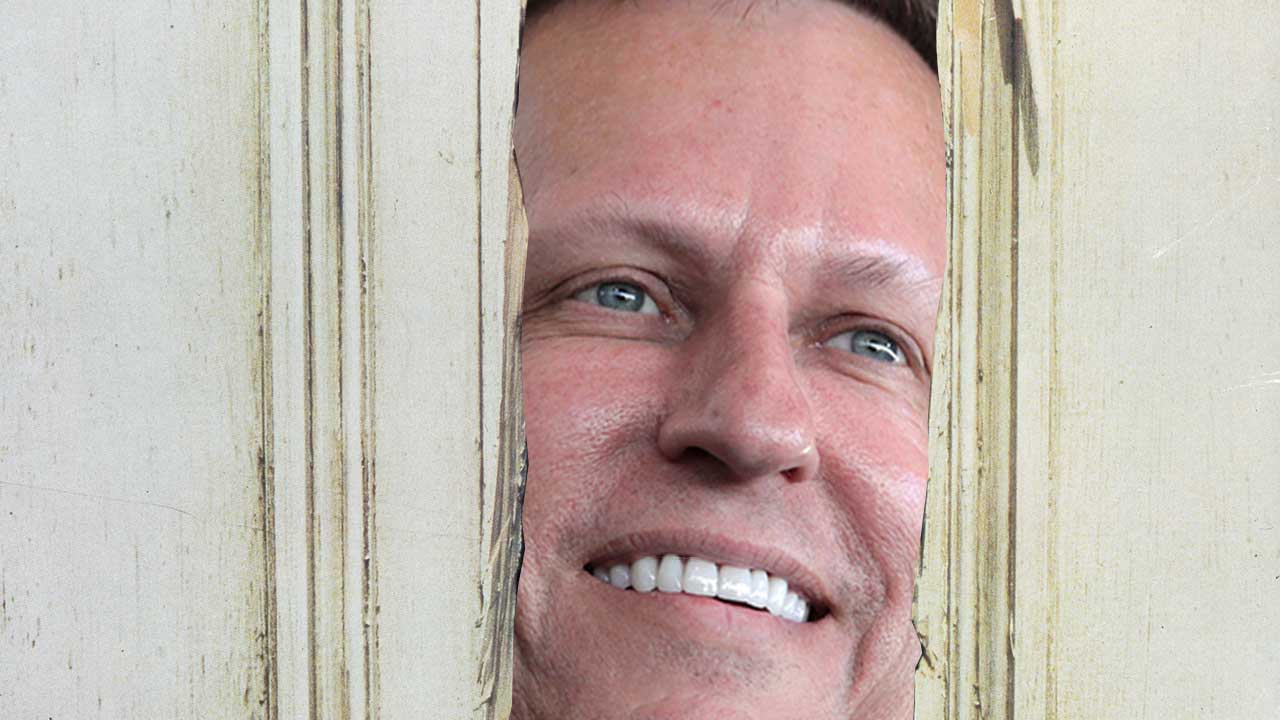
Thiel’s literary analysis follows the same sloppy, associative tropology as those late-night conspiracy videos. He proposes a vague, sinister condition of existence, like the scapegoating of the west by the New World Order. Then, he points to a verse from the Bible, a famously porous and interpretable text, and vaguely gestures at visual elements from another text (One Piece in this case) that correspond to his reading of the Bible verse. There are, conservatively, hundreds of thousands of hours of this kind of content on the internet, and Thiel is clearly placing himself in this same argumentative lineage.
Once establishing that One Piece is a Christian manga, Thiel moved onto the bulk of his lecture, discussing cases for and against empire from what he called “political theology.” The thesis of this second half of the lecture was the notion that Christians should view an expanding empire as good and a complete empire as evil. His justification for this was related to The Great Commission, wherein Christ exhorted his followers to take his message to the people of every nation.
In Thiel’s view, this expansionism of the Holy Spirit correlated to the expansion of various Christian empires throughout history. Once the horizons of the spiritual empire have reached every corner of the globe, then the eschaton will be immanentized and the end-times will begin. Thus, an ever-expanding empire is preferable to a stagnant one that will fester and lead to the rise of the antichrist.
To bolster these claims, Thiel turned to infamous Nazi and mediocre political philosopher Carl Schmitt. Schmitt’s notion of three Christian histories, the great parallel, katachon, and historical phenomenology, is reduced to the notion that the katechon, the restraining force that holds back armageddon, represents government at its best. However, according to Thiel, this overly-regulatory democratic framework is actually working in favor of the antichrist and of armageddon.
Oh, dear, that is somewhat worrisome.
Thankfully, Thiel followed up this unsettling statement with another one of his patented charts for guys who’ve forgotten how to read anything other than LLM outputs. He set up a two-column chart representing the very cool, based “pagan Christianity” versus the lame, cucked, lib-coded “hyper-Christianity.”
For a sample of the oppositions here, he pit Constantine against Mother Theresa, sacred violence against nonviolence, patriarchy against the nanny state, national conservatism against international socialism, and so on. Admittedly, my favorite opposition was that in Thiel’s cool, CHUD Christianity, one goes to church to find a wife, whereas in the wimpy, lame hyper-Christianity, one goes to church to save their soul.
This obsession with reifying the heteronormative, nuclear family and siring children is common among Silicon Valley oligarchs, with Elon Musk’s prodigious capacity for reproduction perhaps most infamously representing this trend. That this belief would perhaps be at odds with Thiel’s own marriage and his self-professed libertarianism is left unaddressed in this lecture, as are the other philosophical, logical, and theological inconsistencies.
Continuing, Thiel proposed that the katechon holding back armageddon from 1949-1989 was anti-communism. Thus, his real point finally rotated into view. He said that we need a new katechon, as well as new heuristics for operating our society. Thankfully, he clarified that “the real technofascist is China,” so we really just need to make sure his businesses are unregulated so we can confront the new evil empire and continue to expand our own.
All told, the second lecture expanded on the themes of the first while also clarifying Thiel’s views on the political and theological elements at play in his lecture series. Thiel is desperate to describe the world in a way that implies that he and his businesses are the katechon holding back Chinese domination, but he simply can’t help himself citing Nazis, calling for “national conservatism,” and begging for a new international military order.
As with his other work, his so-called intellectualism is simply a thinly-veiled misanthropy packaged in a dark edgelord package and utterly lacking in intellectual rigor. Thankfully, I finally got some clarity on the fact that One Piece is a Christian manga, so I’ve got that figured out, at least.