ROKU CITY HAS FALLEN, Media Consolidation Spreads Like Wildfire
Son of billionaire media tycoon Rupert Murdoch, Lachlan K. Murdoch joins son of tech billionaire Larry Ellison in media consolidation blitz this month.

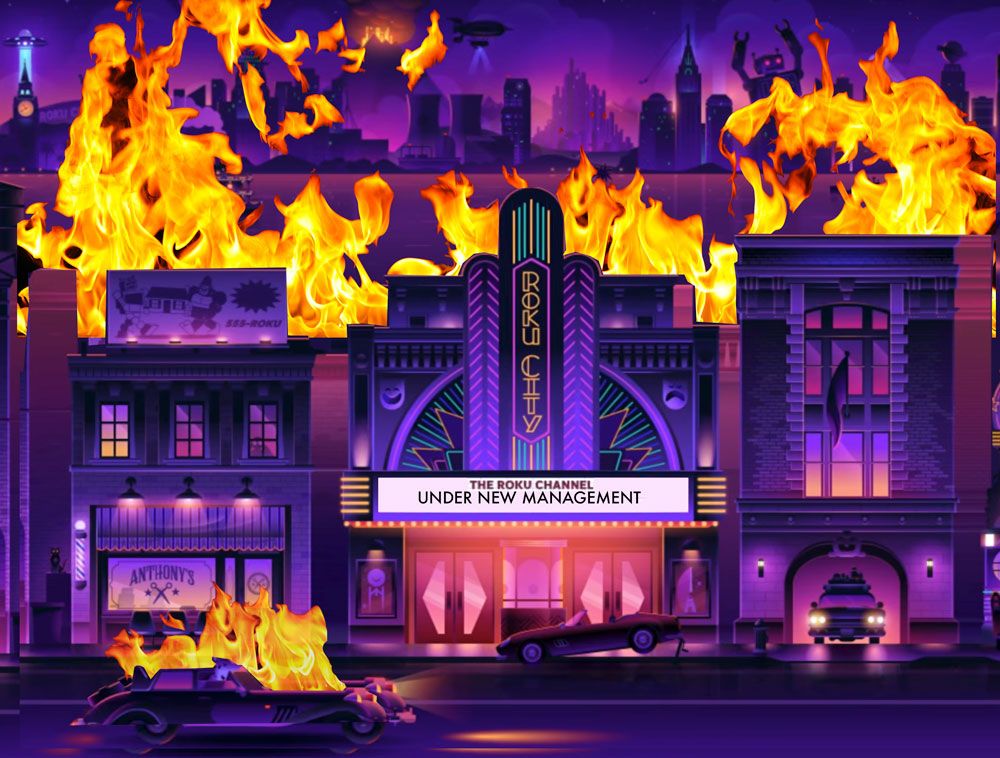

Roku, the consumer electronics and streaming brand, has been purchased by FOX for $22 billion. According to a Roku press release, the deal works out to be “$160.00 per share in a combination of cash and FOX Class A common stock.” The release goes on to confirm that Roku’s “Founder, Chairman and Chief Executive Officer Anthony Wood will have an ongoing role at the combined company and will join the FOX Board of Directors following the close of the transaction.”
As of August 2025, Roku had 38% of the US market for connected TVs; it’s closest competitor was Amazon Fire with 18%
FOX is getting not only the the electronics side of the Roku — which has TVs, streaming dongles and speakers — but also the streaming platforms Howdy and Frndly TV. The move gives Fox access to 100 million Roku users, and a stronger footing back in the streaming game after selling their stake in Hulu during the 20th Century Fox sale to Disney. Fox previously acquired Tubi back in 2020.
This is not the only story of media consolidation happening, as Antitrust Division of the Trump’s Justice Department has cleared the Paramount/Warner Bros deal, claiming it is “not likely to result in harm to competition or American consumers.” The Ellisons, who own Paramount (which includes CBS), also own Skydance Media and a minority stake in TikTok. With the purchase of Warner, they will also acquire CNN and a myriad of other film production companies, streaming services and sports networks including TNT Sports.
This is an accelerated return to the studio system of the 1930s and ‘40s, when a handful of large film studios also owned the method of release — the movie theaters. Back then the Big Five — Paramount, Metro-Goldwyn-Mayer (MGM), Warner Bros., Twentieth Century Fox and RKO — also owned their own distribution network. This meant that smaller production companies couldn’t get access to theaters without the approval of the Big Five. In 1948, the US Supreme Court broke that system up (for the most part) in United States v. Paramount Pictures, et al.
The new studios run by Amazon, Disney, The Ellisons, and Netflix have figured out a way around the 1948 US Supreme Court case by buying themselves a President and thus a friendly DOJ. Trump’s Justice Department ludicrously claims that they looked at the Paramount/WB merger and found… “The evidence reviewed and carefully analyzed by the Division indicates that, post-merger, competition in SVOD [Streaming Video on Demand] is not likely to be harmed. To the contrary, the combined firm is likely to increase competition by offering consumers a more robust competitive alternative to the larger SVOD offerings.”
There has never been a more vital time for movie lovers to start investing in physical media as once again our access to film and TV will be decided by a handful of men that don’t actually seem to like movies or the artists that create them that much.